Partner Visa
A partner visa lets the partner or fiancé of an Australian citizen, permanent resident or eligible New Zealand citizen live in Australia. Ferntree Migration prepares applications and represents refused or cancelled applicants. Led by Cathrine Burnett, MARN 0324641.
Partner Visas for Australia: 820/801, 309/100 and 300
Last reviewed 19 September 2026 by Cathrine Burnett, MARN 0324641
A partner visa lets the spouse, de facto partner or fiancé of an Australian citizen, permanent resident or eligible New Zealand citizen live in Australia. Ferntree Migration prepares and lodges partner visa applications for couples across Australia and overseas, and represents applicants whose partner visa has been refused or cancelled at the Administrative Review Tribunal. The practice is run by Cathrine Burnett, a registered migration agent (MARN 0324641) since 2003 and a member of the Administrative Appeals Tribunal from 2017 to 2021.
The government charge for a partner visa, as of 1 July 2026, is $11,710 and it is not refunded if the application fails. Getting the strategy right before you lodge is the whole game.
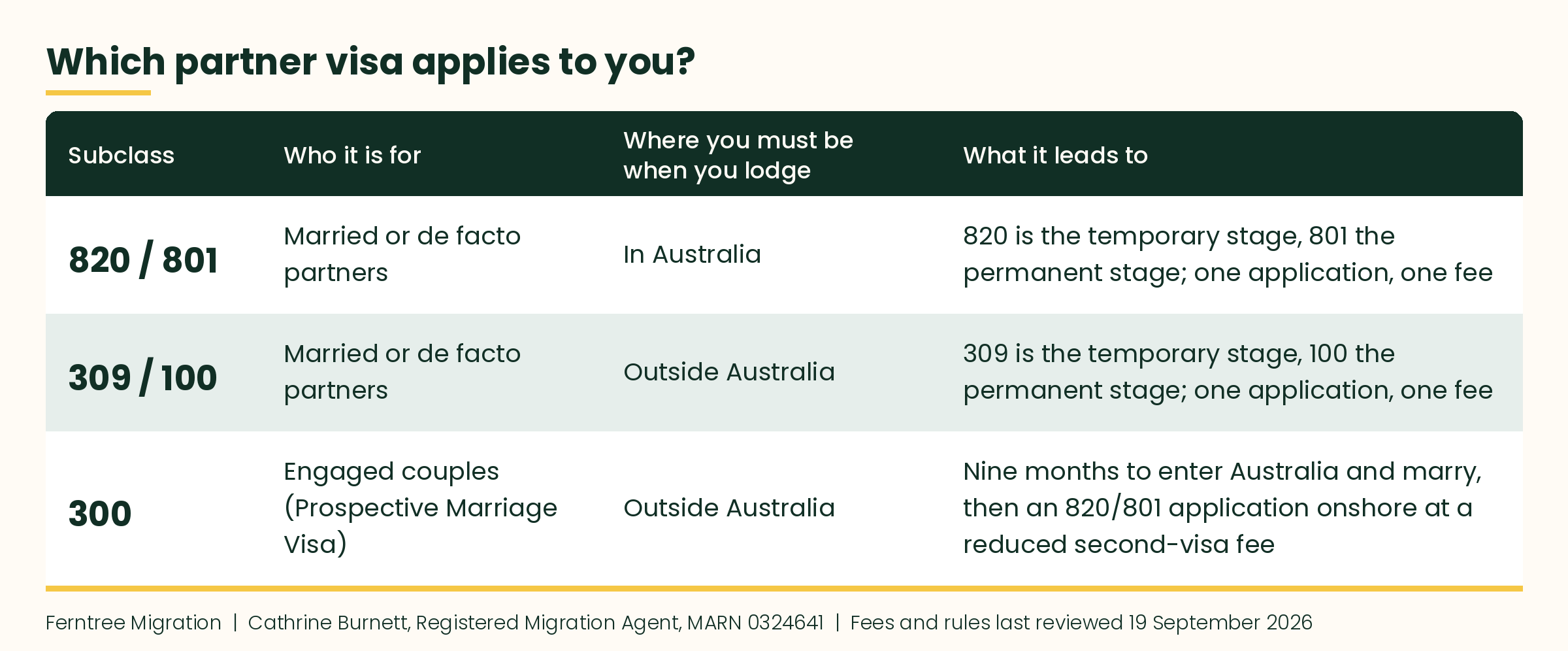
Which partner visa applies to you
The right subclass depends on two things: whether you are married, de facto or engaged, and whether the applicant is in Australia or outside it on the day the application is lodged. Married and de facto couples apply for a combined temporary and permanent visa in one application and pay one fee.
| Subclass | Who it is for | Where you must be when you lodge | What it leads to |
|---|---|---|---|
| 820 / 801 | Married or de facto partners | In Australia | 820 is the temporary stage, 801 the permanent stage; one application, one fee |
| 309 / 100 | Married or de facto partners | Outside Australia | 309 is the temporary stage, 100 the permanent stage; one application, one fee |
| 300 | Engaged couples (Prospective Marriage Visa) | Outside Australia | Nine months to enter Australia and marry, then an 820/801 application onshore at a reduced second-visa fee |
Onshore and offshore lead to the same permanent residence, but the road is different. Onshore applicants may be eligible for a bridging visa with work rights while they wait and cannot leave Australia without a Bridging Visa B. Offshore applicants get no bridging visa, but they can be in Australia on another visa when the 309 is granted, as long as they are not in immigration clearance at that moment. Processing overseas is often faster.
If you are not sure which applies, the two-minute eligibility check will tell you.
What you need to prove
The Department of Home Affairs decides every partner visa on one legal test: is the relationship genuine and continuing? Case officers apply that test using four categories of evidence: financial, household, social, and commitment. A strong application has at least three separate pieces of evidence in each category, spanning at least six months.
For de facto couples there is an extra requirement. You generally need to have been in the relationship for at least 12 months before you apply. That period is waived if the relationship is registered under a state or territory relationship register (available in New South Wales, Victoria, Queensland, South Australia, Tasmania and the ACT), if there are compelling and compassionate circumstances. Registration costs between about $190 and $310 and takes a approximately 4-6 weeks.
The applicant and any children included in the application must meet health and character requirements. That means a medical examination with a panel doctor and police clearances from every country the applicant has lived in for 12 months or more in the last ten years, from the age of 16. Convictions carrying a total sentence of 12 months or more raise the character test under section 501 of the Migration Act and need specific advice before lodgement.
Sponsor requirements
The sponsor must be an Australian citizen, permanent resident or eligible New Zealand citizen and at least 18 on the day the application is lodged. Since 2018 sponsors also pass a character check, and the Department will give the applicant a copy of the sponsor’s police check outcome where there is relevant history.
There are three limits on sponsoring that catch people out. A person can sponsor a maximum of two partners in their lifetime. They cannot sponsor a new partner within five years of lodging a previous sponsorship. And if they came to Australia on a partner visa themselves, five years must have passed since that application was lodged. All three run from the date of lodgement, and all three can be waived in compelling circumstances, but the bar is high and no plan should be built around a waiver without advice.
Applying onshore: bridging visas, Schedule 3 and No Further Stay
If the applicant is in Australia on a substantive visa, lodging an 820/801 application normally results in a Bridging Visa A that starts when the current visa ends. It carries full work rights. It does not allow travel: leaving Australia on a Bridging Visa A ends it, and the applicant cannot return on it. A Bridging Visa B (about $575) must be applied for before any trip, and the reason for travel matters.
If the applicant’s visa has already expired, or they hold a bridging visa rather than a substantive visa, two things change. The bridging visa granted is a Bridging Visa C, which carries no work rights until they are applied for separately. And the application must satisfy Schedule 3 of the Migration Regulations unless the Department waives it for compelling reasons. Schedule 3 refusals are common and the evidence needed for a waiver is specific. We take Schedule 3 matters regularly.
If the current visa carries condition 8503 (No Further Stay), an onshore application is not possible unless the condition is waived. A waiver request is a separate step that must succeed before the partner visa is lodged.
From temporary to permanent
The permanent 801 or 100 stage is not automatic. About 22 months after the original application was lodged, the Department emails an invitation to submit updated evidence for the permanent stage. The two-year clock runs from the date of lodgement, not from the date the 820 or 309 was granted, so if the temporary visa took 18 months only six months of the wait remains.
The Department wants the same four categories of evidence, updated to cover the period since lodgement, plus fresh statements and at least two new Form 888 declarations. Couples who kept a running evidence folder from day one breeze through this stage. Couples who lodged and forgot about the visa for two years have to reconstruct it from memory.
Some applicants are granted permanent residence straight away, without the two-year wait: relationships of five years or more at lodgement, or three years with dependent children.
If the relationship has ended before the permanent stage is decided, permanent residence may still be available in three situations: where the applicant or a family member has experienced family violence by the sponsor, where the sponsor has died, or where there are children of the relationship for whom the sponsor has legal responsibility. Each needs careful evidence and advice before the Department is notified.
Refused or cancelled partner visas: review at the ART
Most onshore partner visa refusals, and many cancellations, can be reviewed by the Administrative Review Tribunal. Offshore refusals can be reviewed only by the sponsor. The time limit runs from the date you are taken to have received the decision, and it is short and strict. Miss it and the refusal stands. The ART lodgement fee for a partner visa review is currently $3,727, partly refundable if the review succeeds, and a hearing is usually twelve to 18 months after lodgement. Your bridging visa continues while you wait.
Cathrine Burnett sat as a member of the Administrative Appeals Tribunal, the ART’s predecessor, from 2017 to 2021, deciding visa refusals and cancellations from the bench. She now prepares partner visa review applications, written submissions and hearing evidence, and appears with applicants at hearings. Read Success in Partner Visa Australia: Overcoming Refusal for how a refusal case is run.
What it costs
The Department’s charges as at 1 July 2026 are set out below. They do not include professional fees, medicals, police checks or translations, and they change every 1 July.
| Charge | Amount |
|---|---|
| Onshore 820/801, main applicant | $11,710 |
| Offshore 309/100, main applicant | $11,710 |
| Prospective Marriage 300 | $11,710 |
| Additional applicant 18 or over | $5,860 |
| Additional applicant under 18 | $2,935 |
| 820 second-visa fee after a 300 | $1,955 |
| Bridging Visa B | $575 |
| ART review lodgement fee | $3,727 |
Our professional fees are fixed and quoted in writing before you engage us. A straightforward onshore or offshore application starts from $5000 plus GST. Schedule 3 submissions, work rights applications and ART reviews are quoted as their own stages, so you only pay for the work your case needs.
If you have already lodged your own application or about to, we offer a fixed-fee review. Cathrine personally reads what you have uploaded, then spends about an hour with you on a video call going through the weaknesses and the further evidence you should provide. The fee is $1100 plus GST.
How we work with you
It starts with a paid consultation with Cathrine, by video. You get a frank read on your case: where the strengths are, where the risks are, and what the sensible next step is. You walk away with a plan whether or not you decide to work with us, and you receive a written summary and a fixed quote afterwards.
If you go ahead, your file is managed under Cathrine’s supervision, with a written engagement agreement that sets out exactly what is included. We work with clients in every state and overseas, so there is no need to come to Melbourne.
Download the free Partner Visa 101 handbook
Partner Visa 101: The Companion Handbook is a 36-page guide written by Cathrine Burnett, updated July 2026. It covers the five eligibility filters to check before you spend a dollar, the onshore or offshore decision, the four categories of evidence Home Affairs actually reads, sponsor limits and character checks, how to write a relationship statement and brief your Form 888 witnesses, bridging visas and the travel trap, the two-year wait to permanent residence, what to do after a refusal, and the Prospective Marriage Visa. It ends with a printable eligibility self-audit and every current fee in one table.
What Clients Say
Our partner visa journey felt overwhelming at first, but Cathrine guided us with patience and clarity every step of the way. She understood our situation, answered every question, and gave us the confidence we needed. Thanks to her dedication, my husband and I can finally start our life together in Australia. We couldn’t be happier with the outcome and highly recommend Cathrine to anyone applying for a partner visa.
Cathrine and her team made what seemed like a stressful process so much easier. From the initial consultation through to the final grant of our partner visa, they were always approachable, knowledgeable, and reassuring. We were impressed with how well-prepared our application was, which gave us peace of mind. We are so grateful to be reunited, and it’s all thanks to Cathrine’s expertise.
Applying for a partner visa can be daunting, but Cathrine’s professionalism and compassion made all the difference. She explained everything in simple terms and kept us updated throughout. Her attention to detail meant our application was strong from the beginning, and the visa was granted much sooner than we expected. We can’t thank her enough for helping us achieve this milestone.
Partner Visa Questions We are Asked Most
How long does a partner visa take in Australia?
As at July 2026 the Department is publishing indicative processing times of around 18 to 24 months for an onshore 820 and around 12 to 20 months for an offshore 309. Individual cases run longer or shorter. Applications lodged with everything the case officer needs are decided faster than applications that draw a request for further information.
How much does a partner visa cost?
The government charge is $11,710 for the main applicant, paid at lodgement, and it covers both the temporary and permanent stages. Additional applicants are $5,860 (18 or over) or $2,935 (under 18). Our professional fees start from $5000 plus GST. Medicals, police checks and translations are extra.
Can I apply for a partner visa while I am in Australia?
Yes, if you hold a substantive visa without a No Further Stay condition, or if you can meet or obtain a waiver of Schedule 3. You will receive a bridging visa while the application is decided.
Do we need to have lived together for 12 months?
De facto couples generally need 12 months in the relationship, unless it is registered under a state or territory register or there are compelling and compassionate circumstances. Married couples have no minimum period.
What evidence does the Department want?
Evidence in four categories: financial (joint accounts with real activity, shared bills, both names on the lease), household (mail to both of you at one address, how you divide the domestic work), social (photos with each other’s families at real events, joint memberships, Form 888 declarations from witnesses) and commitment (wills, powers of attorney, documented long-term plans). Aim for at least three pieces in each category spanning six months or more.
How many Form 888 declarations do we need?
There is no legal minimum. Two is not enough for most cases; six is a solid target. Witnesses must be Australian citizens or permanent residents who have personally observed the relationship, and each should describe specific events they attended rather than a generic paragraph.
Can I work while I wait?
A Bridging Visa A, granted when you apply while holding a substantive visa, carries full work rights. A Bridging Visa C, granted when you apply from a bridging visa or no visa, carries no work rights until you apply for them separately and show financial hardship.
Can I travel while my partner visa is being processed?
Not on a Bridging Visa A. You must obtain a Bridging Visa B before leaving Australia, and the reason for travel matters. If a family emergency overseas is even a possibility, apply for the Bridging Visa B in advance. Offshore 309 applicants can visit Australia on another visa during the wait.
My partner visa was refused. What can I do?
Most onshore refusals can be reviewed at the Administrative Review Tribunal, but the application must be lodged within the time limit in the decision letter. The Tribunal looks at the case afresh, so new evidence can be provided. A hearing is usually nine to twelve months after lodgement and your bridging visa continues while you wait.
What happens if we separate before the permanent visa is granted?
You must tell the Department. Permanent residence may still be granted where there has been family violence by the sponsor, where the sponsor has died, or where there is a child of the relationship. Get advice before you notify the Department, because how the change is presented matters.
Is the Prospective Marriage Visa cheaper than a partner visa?
No. The 300 costs $11,710, and the 820 lodged after the marriage costs a further $1,955, so the total is $13,665 against $11,710 for a straight 820. The 300 is the right visa when you are engaged, outside Australia, do not meet the de facto rule and want to marry in Australia.
Do foreign documents need to be translated?
Yes. Documents translated in Australia should be done by a NAATI-certified translator. Translations done overseas must include the translator’s name, qualifications and contact details.
About Cathrine Burnett
Director & Principal Migration Agent at Ferntree Migration (MARN 0324641)
Cathrine Burnett is the Director and Principal Migration Agent of Ferntree Migration (MARN 0324641). She has been a registered migration agent since 2003 and has worked in Australian immigration law since 1999. From 2017 to 2021 she was a member of the Administrative Appeals Tribunal, deciding visa refusals and cancellations, and she was previously a Member of the Victorian Parliament for the Eastern Victoria Region. She holds a Master of Laws (Migration) from the Australian National University, where she was awarded the Fragomen Prize for the highest results in her year. For 12 years she volunteered at Casey Cardinia Legal Service advising women on temporary visas, and she produced the short film The Last Time I Saw You, about a Hazara refugee settling in Australia, which screened nationally and internationally.
Ferntree Migration is based in Tecoma at the foot of the Dandenong Ranges and works with couples and families across Australia and overseas.
Our Mission
Here at Ferntree Migration, we’re all about offering top-notch expertise and guidance when it comes to Australian migration services. From visa applications to merits reviews, we specialise in strategic immigration counsel. You can trust us to guide you through the appeal processes at the Migration and Refugee Division of the Administrative Appeals Tribunal (AAT). With our vast experience in handling tribunal matters, we’re the ideal advocates for your migration journey.
Our Vision
We to be the leading force in Australian migration, offering unmatched expertise and tailored advice to each client. Our priority is to provide strategic counsel, support genuine applications, and advocate for them at the Administrative Appeals Tribunal. Our goal? To bring hope, safety, and legal clarity through compassionate partnerships, positively impacting lives.
Visa Approved
Years in Business
Client Countries
Address
Unit 3/1579 Burwood Highway Tecoma, Victoria, 3160
Phone
CONTACT US TODAY
Home
About
Services
Blog
Contact